
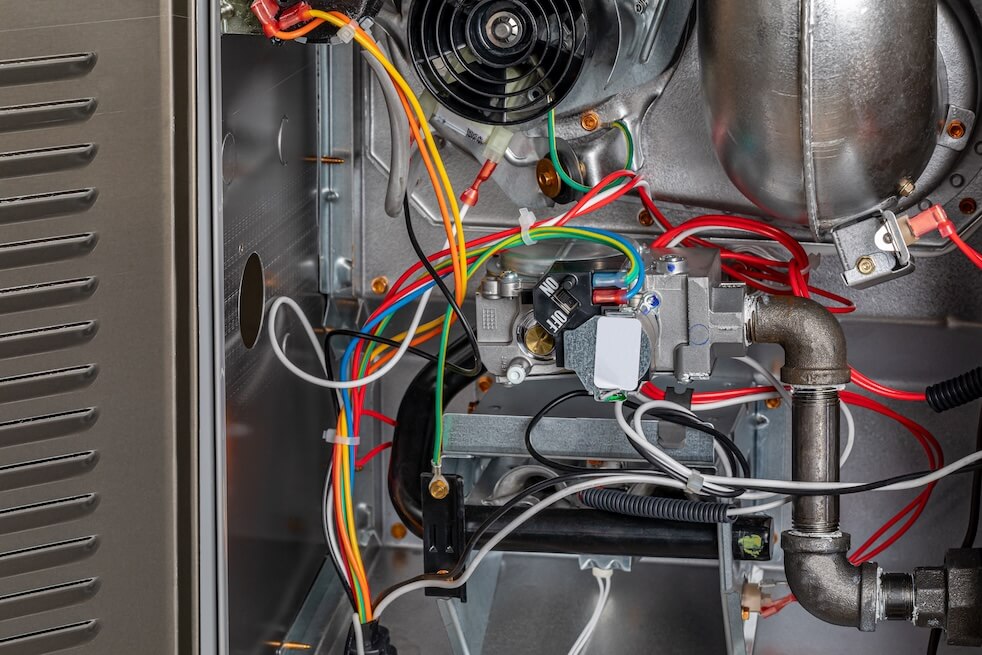
Your Furnace’s Age Helps Technicians Diagnose a Proper Furnace Repair
If you already know your furnace’s age or have looked it up after reading our guide on determining your HVAC system’s age, you’re ahead of most homeowners. Blue Heating and Cooling’s technicians field heater repair calls across the Kansas City metro every week, and age is one of the first things they ask about. If you searched for furnace repair near me because your system just started acting up, here’s what to have ready, and what our team actually looks at once we arrive.
Find Your Furnace’s Age
Every furnace has a nameplate, sometimes called a data plate or rating plate, listing the manufacturer, model number, and serial number. On many units, it’s also stamped with an actual manufacture date. Check the exterior of the furnace cabinet first: the front, side, or top panel that opens without tools is the most common spot.
While you search, don’t remove a panel that exposes wiring, gas connections, the burner assembly, or other internal components. If the plate isn’t somewhere you can safely see, a Blue Heating and Cooling technician can easily identify it during a service visit. Call (816) 719-1099 to schedule a same-day appointment, or use the form on our website.
What Your Serial Number Can (and Can’t) Tell You
Manufacturers like Trane and Lennox encode a manufacture date into the serial number, but the format has changed multiple times over the decades and isn’t the same across every product line. Trane publishes a serial number location guide, and Lennox does, too. However, the nomenclature can be complex. If you want to decode yours, we walk through the basics in our guide to determining your HVAC system’s age.
If you want an accurate, fast read of your furnace’s age, the easiest way to find it is calling Blue Heating and Cooling. Our technicians will be glad to find your unit’s nameplate, or provide its age if we have serviced your home before for a heater repair. Call (816) 719-1099 to find our next available appointment.
What if Your Label Is Missing or Unreadable?
Plates fade, get painted over, or fall off entirely on older equipment. If yours is unreadable, check your installation paperwork, owner’s manual, the original invoice, or any warranty or service records you’ve kept. Homeowners are sometimes surprised what turns up in a folder of old paperwork.
If you still can’t locate it, Blue Heating and Cooling technicians can often narrow down the age using the manufacturer, whatever partial model or serial information remains, and the condition and design of the equipment. That’s true even if you don’t have a Trane or Lennox unit. No matter what brand you have, when you need furnace repaircontacting Blue Heating and Cooling is the place to start.
Furnace Age Is One Piece of the Puzzle for Furnace Repair
An older furnace by itself isn’t an automatic “replace” verdict. According to Trane, a furnace typically lasts 15 to 20 years, but that range depends on how it was sized and installed, and how hard it’s had to work over its lifespan. Kansas City winters can give heaters a real workout, after all. Consistent maintenance is also a big factor, as well as something as simple as changing the filter on schedule.
A 15-year-old furnace that’s been maintained and needs a modest repair is a different situation than a similarly aged furnace that keeps breaking down or is making strange noises and struggling to warm your home. Age is context for the conversation, not the final word.
Call (816) 719-1099 to speak with a friendly Blue Heating technician about how we can help you determine if your furnace needs a tune-up or replacement.
What Our Technicians Check Before Recommending Furnace Repair or Replacement
When we see an older furnace, age is only one input. We also weigh the original reason for the service call and the furnace’s overall condition. We also assess if it’s needed frequent or recurring repairs in the last year.
Taken together, these aspects give us a clearer picture than age alone. We’ll never recommend a replacement simply because a furnace is older. We diagnose first, then explain your options. Schedule a visit and we’ll tell you plainly whether furnace repair makes sense or whether you’re better off planning for something bigger.
Repairs That Become More Common as a Furnace Ages
Wear shows up in predictable places as furnaces get older: ignitors, blower motors and assemblies, capacitors, and electrical controls all see more strain over a long lifetime. That doesn’t mean every 10-20-year-old furnace fails the same way, or fails at all. Plenty of well-maintained systems run for years past their usual lifespan.
It is worth knowing that parts for older or discontinued equipment can take longer to find and sometimes cost more, though that’s not a given. If you’re concerned your unit may be aging out when it comes to replacement parts, you can always contact Blue Heating and Cooling for an honest estimate of its condition.
Signs It’s Time to Schedule a Furnace Repair
A few common patterns tend to show up when a furnace reaches the end of its life. Recurring repairs, especially for the same part, a decline in your home’s comfort, new or strange noises like squealing or rumbling, or a system that noticeably struggles when the temperature drops are all indications you should search for a furnace repair company near you.
Don’t wait out the season guessing whether your furnace is up to the challenge of winter. No one wants to search for heater repair near me at six in the morning because the house is freezing. Call Blue Heating and Cooling at (816) 719-1099 or contact us online to schedule furnace repair, and we can usually get a technician out the same day. Whether it’s a straightforward fix or a bigger decision, you’ll know exactly what you’re dealing with before we leave.